
Industries
College and university cleaning for Sunnyvale-area campuses
College and university cleaning for campuses in and around Sunnyvale: lecture halls, libraries, residence halls, unions, labs and offices, each on a written plan that moves with the academic calendar.
Campus cleaning for Sunnyvale-area facilities teams
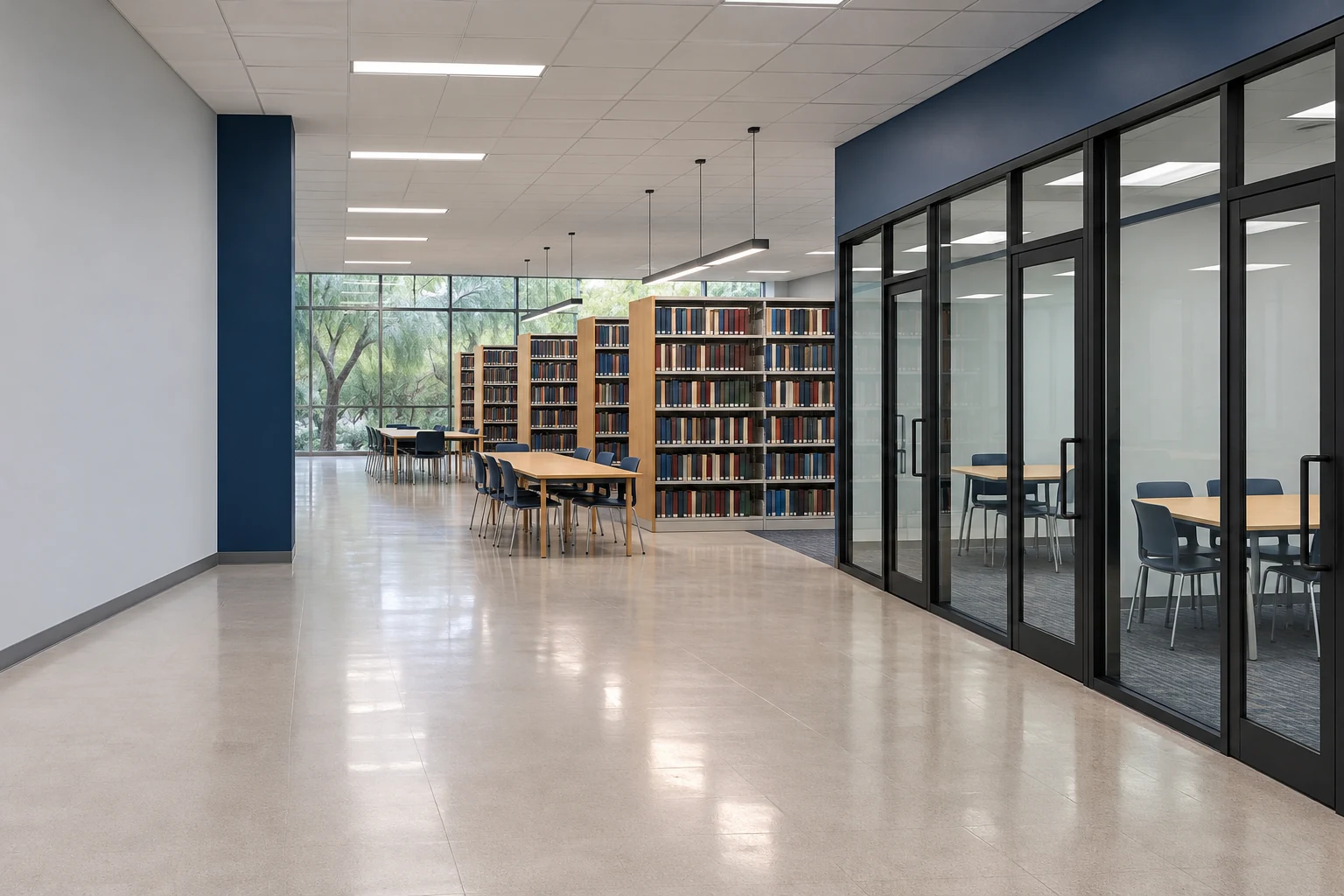
Sunnyvale Janitorial cleans the buildings a college runs every day: classrooms and lecture halls, libraries, residence halls, student unions and dining commons, recreation centers, teaching labs and administrative offices. Each building gets its own written plan listing every room, its tasks and its visit nights, so your facilities office knows what a visit covers before the first one starts.
This page is for the people who keep those buildings open: facilities directors, housing managers, custodial leads and the auxiliary services teams behind unions, dining and recreation. Those offices often answer for different buildings. On many campuses the central custodial team runs the academic halls, while housing, dining, the bookstore and the student union answer to other offices. That is why each building owner gets a plan, a contact and a schedule of its own.
Preschool, K-12 and daycare rooms run on a different routine, covered on our school and daycare cleaning page.
Higher education near Sunnyvale
Around Sunnyvale, college classrooms don’t always sit on a traditional campus; some run out of buildings inside business parks.
A college building in a business-park setting has a lot in common with the shared lobbies and tenant floors on our business park cleaning page, with a class timetable layered on top. Our crews work throughout Sunnyvale and into Mountain View, Santa Clara, Cupertino and Los Altos, so campus buildings on both sides of the city line can sit on one plan.
How we plan college and university cleaning
Each building is planned on its own. A walkthrough records each room type and how it is used, your facilities office sets the frequencies, and the table below is the starting task list we adjust to your rooms.
| Building | On the task list | When the work fits |
|---|---|---|
| Lecture halls and classrooms | Waste and recycling emptied, desks, tables and tablet arms wiped, whiteboards and marker trays cleaned, chair rows squared, floors vacuumed or mopped | After the last evening section, ready for the first morning class |
| Libraries and learning commons | Study tables and carrels, shared computer stations, service desks, book-return counters, entry mats, nearby restrooms | At closing time, with quiet hand tasks while late finals hours run |
| Residence halls | Lounges, corridors, stairwells and shared bathrooms through the term; room-by-room turnover cleaning when residents leave | Common areas on set days each week, turnover crews at move-out |
| Student unions and dining commons | Dining-room tables and chairs, lounge seating, entry glass, restrooms, floors and waste areas | After the last meal period, with a day porter between the lunch and dinner rush |
| Recreation centers | Showers, locker rooms, mats, equipment touchpoints and court-side benches | Before opening and after the late crowd leaves |
| Teaching labs | Trash, floors, sinks and shared counters once the lab has cleared its benches | On the days and in the order the lab’s protocol sets |
| Administrative offices | Desks, service counters, conference rooms, break rooms and copy areas | Evenings, weighted toward the days the offices are full |
The room-type approach mirrors how APPA, a professional organization for educational facilities, builds its staffing method: classrooms, libraries, offices, research labs, restrooms and stairwells each count as their own room type. Labs get more detail on our cleanroom, data center and lab cleaning page, locker rooms and courts on our gym and fitness center cleaning page, and office floors on our office cleaning page.
Visit frequency for each room is the campus’s call. A typical campus plan sets daily trash, desk and board cleaning, chair alignment and vacuuming in classrooms, with dusting every two weeks, and daily disinfection and restocking in restrooms. Your own frequencies go on your plan.
Fitting the work to the academic year
A campus plan changes with the calendar. Steady nightly routes carry the term, and the heavy projects move into the weeks when rooms stand empty. Here is the year as a campus plan lays it out:
- First week of classes: every classroom reset, dispensers filled and entry glass cleared before the first lecture.
- Mid-term nights: steady academic-building routes, residence hall common areas on their set days, extra restroom rounds where traffic peaks.
- Finals weeks: libraries and study rooms stay open late, so crews keep to quiet hand work while students study and run machines after close.
- Move-out and move-in: residence hall rooms and corridors turned over between the last departure and the next arrival.
- Winter break and summer: floor stripping and refinishing, carpet extraction, restroom deep cleaning and low-rise window cleaning while classrooms sit idle.
Summer seldom means a quiet campus. Residence halls often host conference groups, so bathrooms, lounges, hallways and stairwells need cleaning while the groups stay, with a log of the rooms and areas cleaned each day. Our crews carry that common-area work and keep the daily log in the format your housing office uses.
Break-week projects come from our commercial floor care, commercial carpet cleaning, restroom deep cleaning and window cleaning services. If you are deciding between a full strip and a lighter recoat, our guide to floor stripping versus scrub and recoat lays out the trade-off.
Who sets the cleaning standard
The campus does. Many facilities offices state their target using APPA’s five custodial appearance levels, and your task list and frequencies are written to the level you pick for each building. Your inspectors then judge visits against that level.
APPA’s levels run from 1, the cleanest, to 5, the most neglected, with its own labels ranging from Orderly Spotlessness at Level 1 to Unkempt Neglect at Level 5. In short, as APPA’s cleaning operations chapter describes them:
| APPA level | What a visitor would see, in brief |
|---|---|
| Level 1 | Floors and base moldings bright right to the edges, no dust, streaks or fingerprints, restrooms gleaming and stocked, only the day’s trash in the bins, every light working |
| Level 2 | Floors still bright with clean corners, up to two days of dust or streaks showing, marks visible only up close, restrooms and trash held to the Level 1 standard |
| Level 3 | Floors swept or vacuumed but stained on close look, build-up along walls and dull traffic lanes, obvious dust and fingerprints |
| Level 4 | Dull, stained floors with clear build-up, conspicuous dust, old and sour-smelling trash, up to 5% of lamps out |
| Level 5 | Old dirt and finish built up, gum, dust balls and trash spread around, overflowing bins, more than 5% of lamps out |
APPA also says service levels should be settled together with building occupants and custodial staff, and written down plainly so nobody has to guess which tasks happen or at what interval. A room-by-room plan with a frequency beside every task gives your office exactly that to point to.
Keys, background checks and product records
Your campus sets the rules for keys, screening and chemicals, and our crew works inside them. Published campus policies show what those rules look like.
Many campuses require facilities sign-off before keys go to an outside company, issue one copy per holder, put an expiration date on company keys and bar loaning or duplicating them. Every key and card issued to our crew goes back the moment your office asks for it.
Background checks are also the campus’s decision. Some campus policies call for added checks on contract workers in sensitive roles or in regular contact with minors, such as staff at campus-hosted camps. Our cleaners are background-checked before they join a crew; send your policy with your request so the crew plan reflects what it asks for.
A contract crew shares each building with campus staff and their chemicals. Each side needs to know which chemicals the other brings into the building, and Safety Data Sheets need to be within reach on every shift. We hand our product list and Safety Data Sheets to your facilities and lab contacts before the first night, and our SDS binder kit shows one way to keep them in reach.
For high-touch surfaces such as restroom fixtures, elevator buttons, door handles, stair rails and desks, CDC guidance says to clean first and then use an EPA-registered disinfectant, keeping the surface wet for the contact time on its label. Crews work that way, and campuses that want added rounds can book them through disinfection and sanitizing.
Events, porters and restocking
Orientation, open houses, receptions and commencement add traffic on top of the routine. Event cleaning covers a refresh before the event, trash and restroom rounds during it, and a bigger cleanup afterward so the building is back in shape for regular service the following day, evenings and weekends included. A week’s notice works best, with the place, the date, start and end times, expected guests and what food will be served.
We plan campus event cleaning from those same details. Send them with your request and the extra crew hours are scheduled around your regular route, so the building opens clean the next morning.
Busy public spaces often need someone on site in daylight. APPA notes that day cleaning keeps staff visible and able to fix problems on the spot, while cleaning around people in a room is slower going, so academic buildings can stay on night routes while a day porter covers union restrooms, dining tables between meal rushes and lobby spills. Paper towels, tissue, hand soap and can liners come from our janitorial supplies service or your own stock, and staff kitchens can add breakroom and pantry restocking.
Get help scoping your campus
Send your building list, term calendar and the appearance level or frequencies your office uses through our quote request. We set up a walkthrough, then send a written quote for each building with every room and task on it. Price follows square footage, room types, visit nights, floor projects and event hours, and our Sunnyvale cleaning cost guide explains how commercial pricing comes together. Insurance, a bond and workers’ compensation cover every crew, supervisors make quality inspections, and a certificate of insurance goes into your vendor file before the first night.
A few useful answers
Common questions
Can one contract cover academic buildings and residence halls?
Yes, with a written plan for each. Academic buildings, housing and unions are often run by different campus offices, so each plan names its own contact, rooms and visit nights, and the quote shows the plans side by side.
Do you work to our APPA appearance level?
Your facilities office picks the level and uses it to judge the work. Tell us the level and frequencies you use for each building, and the room-by-room task list is written to match, so your inspectors can check every visit against it.
What do crews do in teaching labs?
Crews empty trash, clean floors and sinks and wipe shared counters after the lab has cleared its benches, on the days and in the order the lab’s written protocol sets. Controlled rooms follow the steps on our cleanroom, data center and lab cleaning page.
Can stripping and carpet work wait for summer?
Yes. Floor stripping and refinishing, carpet extraction and restroom deep cleaning are booked for winter break and summer, when classrooms and halls stand empty, while the term routes keep their usual nights.
Who decides whether cleaners need extra background checks?
Your campus does, under its own policy. Every one of our cleaners is background-checked before joining a crew, and your policy decides which work counts as sensitive and what added checks it asks for.
Can you add crews for orientation or commencement?
Yes. Event cleaning is booked on top of the regular route: a refresh beforehand, restroom and trash rounds during the event and a cleanup afterward. Give us a week’s notice, with where and when the event runs, how many guests are coming and what food is planned, and the crew is set.